The Real Implementation Guide: What Nobody Tells You About SOSTAC® + Flywheel
Turn SOSTAC + Flywheel into measurable ROI
This is my personal take as CMO at Digital Flow Agency EU, sharing how to really implement SOSTAC® + Flywheel to move beyond theory and into results.
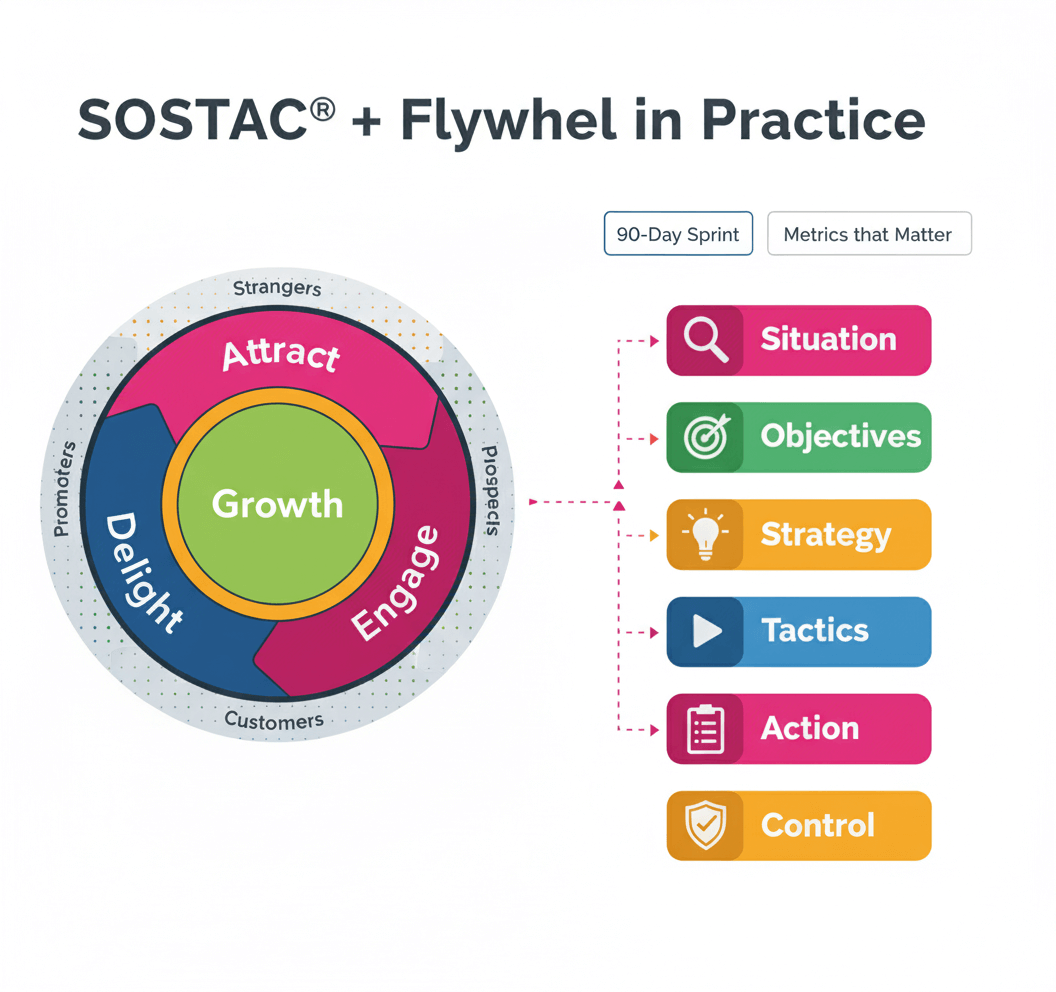
The Hidden Challenge of SOSTAC + Flywheel Most Miss
Everyone talks about the Flywheel model, but here’s what they don’t tell you: your flywheel will spin backward first. In the first 90 days, you’ll invest more energy than you get back. This is normal, not failure.
The mistake I see repeatedly is people giving up during the “energy investment phase” because they expect immediate returns. The flywheel principle works, but only if you understand the physics: it takes significant force to get a heavy wheel moving, then momentum takes over.
The SOSTAC® Reality Check Nobody Discusses
Situation Analysis: Most skip the uncomfortable truth-telling. Your real situation isn’t just “low visibility.” It’s often deeper issues like inconsistent messaging, no clear value proposition, or targeting everyone (which means targeting no one).
Here’s a practical exercise I use with clients:
• Write down your last 10 pieces of content
• Ask: “Would I pay money to read this?”
If the answer is no, you’ve found your starting point.
Objectives That Actually Work
Forget “500 LinkedIn followers.” That’s vanity. Set business objectives:
• Generate 20 qualified leads per month from content
• Book 5 discovery calls weekly from LinkedIn engagement
• Achieve 15% conversion rate from content to email subscribersThese connect directly to revenue, which keeps you motivated during tough months.
The Strategy Gap: Content-to-Conversion Bridge
The original article mentions content pillars but misses the conversion architecture. Every piece of content needs three elements:
• Hook: addresses a specific pain point
• Value: provides actionable insight
• Bridge: clear next step (not always a sale)
Example: Instead of “5 SEO tips,” try “Why your SEO isn’t working (and the one change that fixes it).” Then bridge: “Want the complete checklist? Link in comments.”
Tactical Reality: The 90-Day Sprint
Most people think SOSTAC® is a yearly plan. I’ve learned it works better as 90-day sprints:
• Days 1–30: Content audit and competitor gap analysis
• Days 31–60: Content production and initial automation setup
• Days 61–90: Performance analysis and flywheel optimization
This keeps you agile and prevents the “paralysis by planning” trap.
The Automation Sequence They Don’t Teach
Everyone mentions Zapier and Make, but here’s the actual sequence that works:
1. Lead Magnet: specific solution to a specific problem
2. Welcome Email: immediate value delivery
3. Educational Series: 5–7 emails over 2 weeks
4. Social Proof: case study or testimonial
5. Soft Offer: low-commitment next step
6. Direct Invitation: clear call to action
Control Phase: The Metrics That Matter
Forget vanity metrics. Track these instead:
• Content-to-Conversation Rate: how many comments turn into DMs?
• DM-to-Discovery Rate: how many conversations become calls?
• Discovery-to-Client Rate: your closing percentage
• Client-to-Referral Rate: the flywheel indicator
The Biggest Mistake I See
People try to optimize everything at once. Focus on one part of the flywheel at a time:
• Month 1: Attract (content quality)
• Month 2: Engage (conversation conversion)
• Month 3: Delight (client experience)
My Contrarian Take
Most “thought leaders” are actually just loud voices. Real authority comes from consistent problem-solving, not perfect posting. I’d rather see you help 10 people deeply than impress 1,000 superficially.
What This Means for You
If you’re starting from zero, expect this timeline:
• Months 1–3: Building foundation, low visible results
• Months 4–6: Initial momentum, some leads
• Months 7–12: Flywheel effect kicks in, exponential growth
The businesses that succeed understand this isn’t a quick fix. It’s a systematic approach to becoming indispensable in your market.
Your Next Action
Pick one pain point your ideal client has that you can solve in 10 minutes. Create content around that solution. Do this daily for 30 days. That’s your flywheel foundation.
What’s the one pain point you’re going to tackle first? Share it below, and I’ll give you a content angle that converts.