How to Start Digital Marketing from Zero
A Step-by-Step Strategy for Growth
Starting a digital marketing strategy from zero often feels overwhelming.
Common pain points include invisibility, low lead generation, no clear plan, and wasted effort.
But growth doesn’t need to be chaotic — with the right frameworks, you can transform confusion into a structured roadmap for sustainable growth.
In this guide, we’ll explore two frameworks:
– **The Flywheel** → your “why,” a growth mindset for sustainable momentum.
– **SOSTAC®** → your “how,” a practical plan for building authority and visibility.
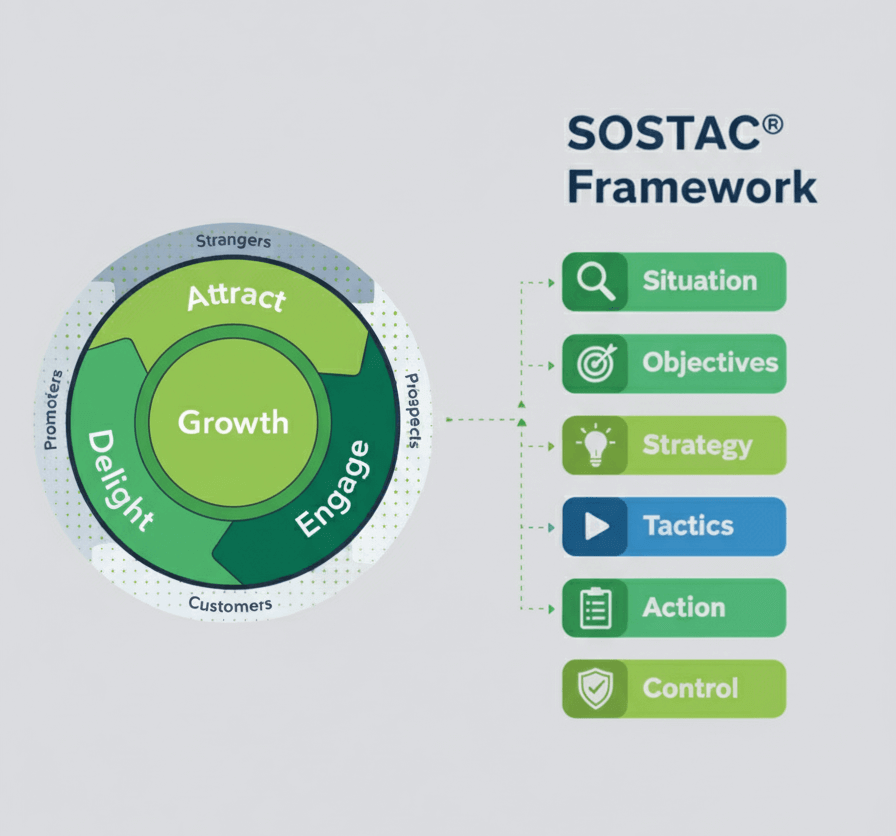
The New Growth Game – Why Old Funnels Fail in Digital Marketing Strategy
For decades, marketers lived by the funnel: attract prospects at the top, push them down the pipeline, and convert them at the end. But the funnel is broken. Why? Because it treats customers as an output, not the engine of growth.
Enter the Flywheel model. Popularized by HubSpot and adopted globally in 2025, the Flywheel is a continuous growth loop:
- Attract prospects with valuable content.
- Engage them with personalized, authentic interactions.
- Delight them so deeply that they become your advocates.
Unlike the funnel, the Flywheel reduces friction and creates momentum. Satisfied customers feed the cycle, turning marketing into a compounding engine.
📊 Data point: 80% of B2B leads on social media now come from LinkedIn. This isn’t about cold pitching—it’s about sustained engagement and credibility-building.
Your Blueprint for Success – A Digital Marketing Strategy from Zero with SOSTAC®
The Flywheel explains why growth happens. The SOSTAC® framework explains how to make it happen.
Step 1: Situation – Where Are You Now?
- Audience Analysis: Define your buyer personas. Entrepreneurs? Small business owners? Their pain points: invisibility, wasted effort, poor ROI.
- Competitor Analysis: Who’s already visible? What formats do they use (articles, carousels, videos)? Where are the gaps you can fill?
- SWOT: Be honest. Strengths (expertise). Weaknesses (low visibility). Opportunities (content gaps). Threats (rising ad costs, crowded feeds).
Step 2: Objectives – Where Do You Want to Be?
Without clear goals, marketing becomes guesswork. Use:
- SMART Goals: Specific, measurable, achievable, relevant, time-bound.
- Example: “Gain 500 new LinkedIn followers in 3 months.”
- OKRs (Objectives & Key Results): Push beyond comfort.
- Example: “Become the go-to educational resource in our niche within 12 months.”
Step 3: Strategy – How Do You Get There?
Your overarching strategy: become a trusted authority by consistently creating high-value, E-E-A-T-compliant content (Experience, Expertise, Authority, Trust).
This is exactly where the SOSTAC® framework helps: it turns scattered ideas into a clear plan, making it easier to build a digital marketing strategy from zero that is structured and measurable.
Content pillars:
- Digital Strategy & Growth – frameworks like Flywheel, SOSTAC®, goal-setting.
- Social Media Execution – practical how-tos for Instagram, LinkedIn, automation.
- Web Design & SEO Foundations – websites as growth engines, SEO checklists.
Step 4: Tactics – The Execution Details
This is where strategy meets action:
- Content Hub: Your website/blog is the “home base.” Build it on WordPress + Elementor for speed and flexibility.
- Formats:
- Carousels → break down complex topics visually (LinkedIn & Instagram).
- Reels → fast reach and human connection (4x/week recommended).
- Long-form blog articles (1500+ words) → SEO authority + deep trust.
- Channels:
- LinkedIn → main B2B lead source (80% of social leads).
- Instagram → short-form storytelling + community building.
- Facebook → repurpose Instagram content for wider reach.
- SEO: Optimize every piece. Titles, meta descriptions, headers, URLs. Authority grows when people can find you.
Step 5: Action – Make It Real
- Editorial Calendar: Plan by week, not by chance. Consistency beats intensity.
- Automation: Tools like Zapier or Make for lead nurturing. Example: new blog subscriber → receives checklist → invited to webinar.
- Agile Execution: Work in sprints. Publish → analyze → adapt. Fast learning cycles > slow perfection.
Step 6: Control – Measure and Improve
- KPIs: engagement rate (target: 5% on carousels), follower growth, website traffic, qualified leads.
- Tools: Google Analytics, LinkedIn Analytics, Instagram Insights.
- Feedback Loop: Data → feed back into next “Situation” analysis. The cycle never stops.
Conclusion – From Zero to Thought Leader
By applying this roadmap, your digital marketing strategy from zero evolves into a clear, long-term growth engine that builds trust, visibility, and authority.
You don’t need hacks. You need a system.
- The Flywheel ensures growth is sustainable and client-driven.
- The SOSTAC® framework gives you a clear roadmap from where you are to where you want to be.
- Together, they transform you from invisible to influential.
The outcomes are clear:
- Sustainable growth.
- Stronger visibility and authority.
- Higher quality leads.
- Unshakeable trust.